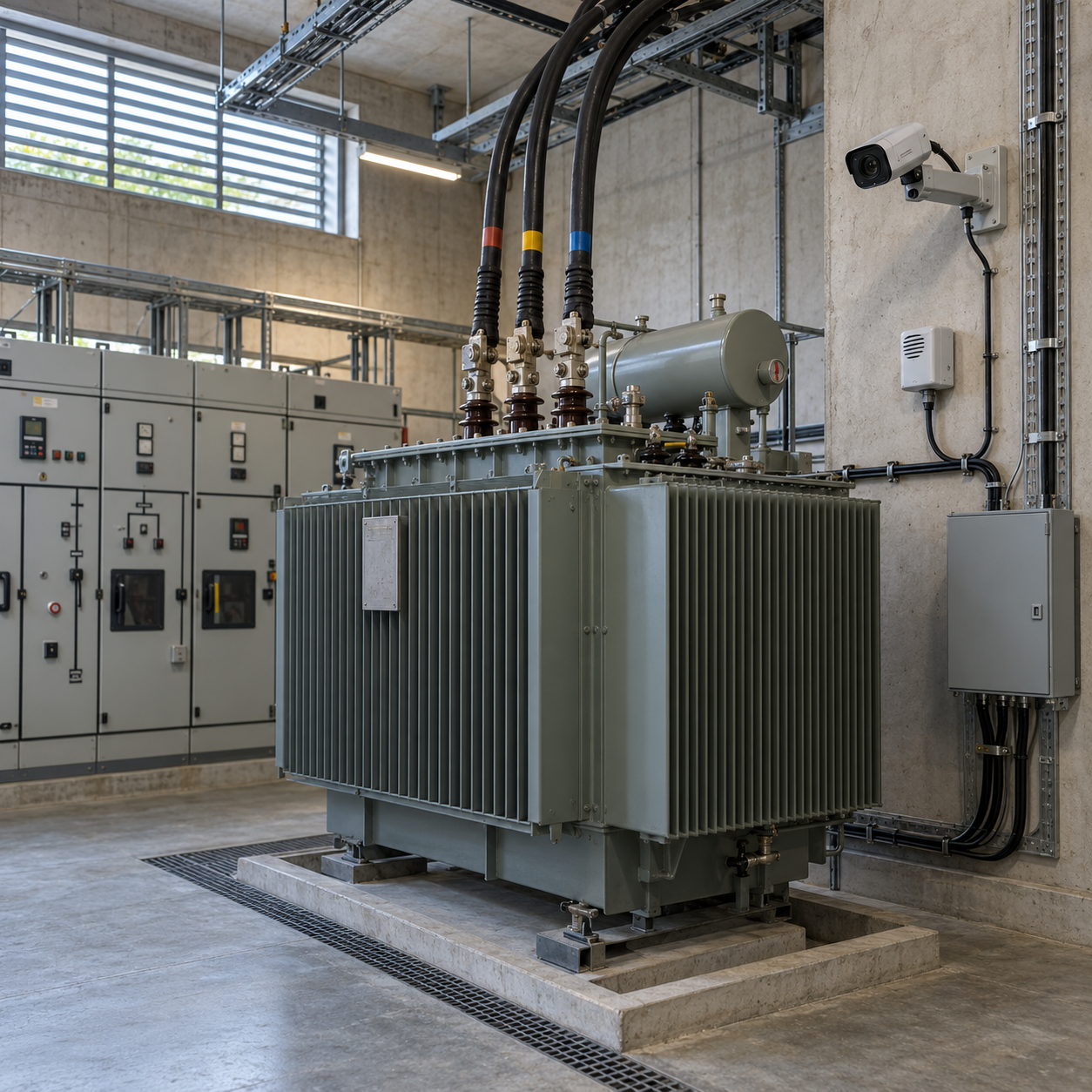
Power grid digitalisation has progressed unevenly. Between primary substations and smart meters, many MV/LV distribution substations still lack continuous information on equipment condition. Knowing that a site has lost supply does not reveal whether it is flooded, experiencing a thermal anomaly or safe to restore.
SmartSense is an architecture jointly developed by Phygital X, MASENSE TECH and CIC Consulting Informático within the MASENTINEL project. It combines signals from different physical phenomena, local processing and operational intelligence to turn measurements into events that help teams decide where to act and with what priority.
From isolated readings to events
A variable exceeding a threshold does not always explain what is happening. SmartSense proposes correlating several concurrent sources of evidence to characterise each event:
- Incipient fire: particles, volatile organic compounds, temperature and thermal imaging.
- Thermal anomaly: thermal camera and temperature probe.
- Flooding: water level and humidity.
- Intrusion: radar, thermal camera and imagery.
- Partial discharge: ultrasound, ozone, HFCT and TEV.
The paper also covers signals associated with SF6 leaks, corona or electrical arcing, condensation, deteriorating connections and earthing. The intended output is an event with a type, confidence level and criticality, supporting notifications, triggered image recording or work-order creation.
A four-layer architecture
- Acquisition and interoperability: incorporates sensors and existing equipment through protocols such as OPC-UA, Modbus and IEC 61850.
- Edge node: performs acquisition, processing and signal fusion locally, with local storage and power management. Its design target is to maintain data capture and diagnostics for 48 hours under degraded communications and power conditions.
- Operational intelligence: relates events and historical information to assets and network topology to develop health and criticality indices.
- Operational integration: connects diagnostics with the utility's SCADA, GIS and CMMS systems to support operations, work orders and planning.
Prioritising by condition and criticality
The approach complements age-based and scheduled maintenance criteria with evidence of actual asset condition. Two transformers in similar condition may require different intervention priorities depending on the loads they supply and the alternative supply paths available.
Linking condition to the consequences of failure supports intervention priorities and helps allocate field resources during incidents affecting multiple sites.
Interoperability and security by design
The architecture includes provisions for device identity, verified boot, segmentation, signed updates and decision traceability. The paper references IEC 62443, NIS2 and the Cyber Resilience Act, and proposes aligning the data model with the Common Information Model. These references do not constitute a claim of certification.
Validation in real distribution environments
Validation in distribution environments is ongoing. Four aspects are to be assessed: reduction in false positives compared with simple thresholds, early anomaly detection, incident response time and edge-node continuity over the target 48-hour period.
The challenge is to verify integration with a heterogeneous installed asset base without replacing existing equipment. Economic improvements cited in industry literature should not be interpreted as results already demonstrated by SmartSense.
The approach combines three architectural choices: characterising events, placing diagnostic capability at the asset and integrating existing instrumentation. The aim is to provide useful information on condition, criticality and intervention priorities.